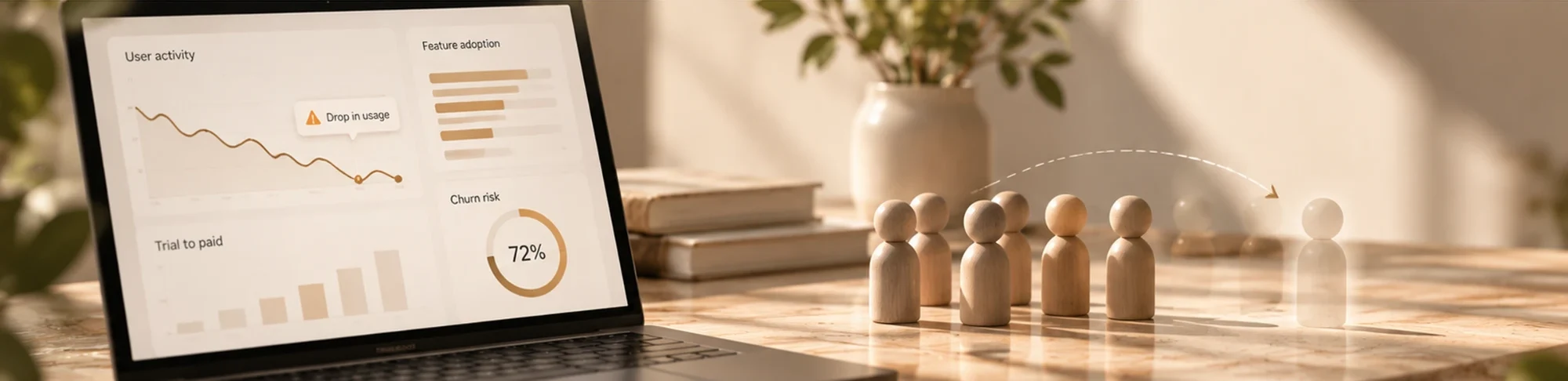
But a few weeks later, customers start cancelling. You check the cancellation reasons. Some say it’s too expensive. Others say they don’t need the product anymore.
But here’s a question. Did they really decide to leave that day? Or had they been slowly disengaging for weeks?
Most customers don’t wake up one morning and randomly decide to cancel a subscription. Sometimes, the warning signs are already there. You just need to know where to look.
Your customers are telling you something. Are you listening?
Think about how people use your product.
- Has someone who used to log in every day suddenly stopped?
- Are customers signing up but never completing onboarding?
- Have they stopped using the features that originally made your product valuable?
These behaviours might indicate something isn’t working. But there’s a catch. Not every inactive user is an unhappy customer.
Imagine an automation tool that runs perfectly in the background. Its customers might rarely log in because the product is doing exactly what they need.
So before treating inactivity as a problem, ask yourself: what does a successful customer actually look like for our product?
Find the patterns behind churn
Start by comparing customers who stayed with those who cancelled. Look at their onboarding experience, product usage, support interactions and how their behaviour changed over time.
- Do certain customer segments leave more frequently?
- Does churn tend to happen after a specific point in the customer journey?
- Are customers who never reach their first meaningful outcome more likely to cancel?
With enough historical data, predictive models can help identify accounts showing similar patterns. But prediction alone won’t save your customers.
Knowing who might leave is only half the job
Let’s say your analysis identifies a group of customers struggling with onboarding. What do you do?
Send them another promotional email? Or investigate what they’re struggling with, simplify the experience and help them achieve the outcome they originally signed up for?
Sometimes the solution isn’t another marketing campaign. It’s fixing a frustrating product experience. And sometimes, the best way to reduce churn is to talk to the customers who already left.
One final question
You’re probably tracking how many customers you’re acquiring. But are you paying just as much attention to the moments when they stop getting value from your product?
Because sustainable growth isn’t only about bringing more customers in. It’s also about giving them a reason to stay.
At IntuitaGo, we combine customer research, behavioural analytics and retention strategies to help SaaS and subscription businesses understand churn and identify opportunities to reduce it.